
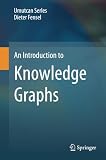
An introduction to knowledge graphs / by Umutcan Serles and Dieter Fensel.
Material type: TextPublisher: Cham, Switzerland : Springer, c2024Description: xxiv, 434 pages : illustrations (black and white) ; 23 cmContent type: text Media type: unmediated Carrier type: volume ISBN: 9783031452550 [paperback]Subject(s): Knowledge graphs | Semantic Web | Database management | Ontology
| Item type | Current location | Call number | Status | Date due | Barcode |
|---|---|---|---|---|---|
 Subject Reference
|
College Library Subject Reference | 001.4226 Se67 2024 (Browse shelf) | Available | 3UCBL000029686 |
Includes bibliographical references
Contents: Part I Knowledge technology in context -- 1 Introduction -- 2. Artificial intelligence -- 3. Information retrieval and hypertext -- 4. The internet -- 5. The world wide web -- 6. Natural language processing -- 7. Semantic web: or AI revisited -- 8. Databases -- 9. Web of data -- 10. Knowledge graphs -- Part II Knowledge representation -- 11 Introduction to knowledge representation -- 12 The five levels of representing knowledge -- 13. Epistemology -- 14. The logical level -- 15. Analysis of schema.org at five levels of KR -- 16 Summary -- Part III Knowledge modeling -- 17. Introduction: the overall model -- 18 Knowledge creation -- 19 Knowledge hosting -- 20. Knowledge assessment -- 21. Knowledge cleaning -- 22. Knowledge enrichment -- 23. Tooling and knowledge deployment -- 24. Summary -- Part IV Applications -- 25. Applications,
"This textbook introduces the theoretical foundations of technologies essential for knowledge graphs.
It also covers practical examples, applications and tools.
Knowledge graphs are the most recent answer to the challenge of providing explicit knowledge about entities and their relationships by potentially integrating billions of facts from heterogeneous sources. The book is structured in four parts. For a start, Part I lays down the overall context of knowledge graph technology.
Part II “Knowledge Representation” then provides a deep understanding of semantics as the technical core of knowledge graph technology.
Semantics is covered from different perspectives, such as conceptual, epistemological and logical.
Next, Part III “Knowledge Modelling” focuses on the building process of knowledge graphs.
The book focuses on the phases of knowledge generation, knowledge hosting, knowledge assessment, knowledge cleaning, knowledge enrichment, and knowledge deployment to cover a complete life cycle for this process.
Finally, Part IV (simply called “Applications”) presents various application areas in detail with concrete application examples as well as an outlook on additional trends that will emphasize the need for knowledge graphs even stronger. This textbook is intended for graduate courses covering knowledge graphs.
Besides students in knowledge graph, Semantic Web, database, or information retrieval classes, also advanced software developers for Web applications or tools for Web data management will learn about the foundations and appropriate methods." --Backcover
Adult
Purchased Ortega, Eric College of Computer Studies Computer Science
Text in English
There are no comments on this title.