
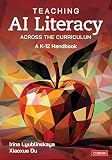
Teaching AI literacy across the curriculum : a K-12 handbook / Irina Lyublinskaya, Xiaoxue Du.
Material type: TextPublisher: California : Corwin, c2025Description: xxviii, 240 pages : colored illustrations ; 25.2 cmContent type: text Media type: unmediated Carrier type: volumeISBN: 9781071964712 [paperback]Subject(s): Computer literacy -- Study and teaching | Educational technology
| Item type | Current location | Call number | Status | Date due | Barcode |
|---|---|---|---|---|---|
 Subject Reference
|
College Library Subject Reference | 371.3 L99 2025 (Browse shelf) | Available | 3UCBL000029913 |
Includes bibliographical references, glossary, and index.
Contents: Part I Theoretical foundations — 1 Ethics and global perspectives on AI literacy education — 2 Pedagogical framework for AI literacy — 3 Applying our pedagogical framework for AI literacy — 4 Preparing to integrate AI literacy into existing curriculum — Part II Practical applications — Part III Framework revisited — Glossary — References — Index.
"AI is reshaping the future of education. Are your students ready?
In an era where artificial intelligence (AI) is revolutionizing every facet of life, from how we shop to how we get our news, it’s inevitable that AI is changing the way we teach and the way students learn. For students to thrive in this world, they need more than just the ability to use technology; they need to understand how it works, its potential, and its limitations. They need AI literacy.
Teaching AI Literacy Across the Curriculum delves into the symbiotic relationship between AI and education, providing cutting-edge research and practical strategies to seamlessly incorporate AI literacy into teaching across disciplines. Authors Irina Lyublinskaya and Xiaoxue Du introduce a pedagogical framework for teaching AI literacy that explores the Big Five Ideas in AI and integrates with practical strategies for teaching AI core concepts across different subjects.
Divided into three parts, focusing on theoretical foundations, practical examples, and assessment of AI literacy, this book
Offers guidance on integrating AI literacy across various subjects, such as Science, Mathematics, English Language Arts, and Social Studies
Provides real-world examples that provoke thoughtful discussions on the ethical considerations and biases inherent in AI
Helps teachers to foster critical thinking to ensure that students are well-prepared for the AI-driven future
Includes a companion website with access to a wealth of resources such as lesson plans and supplemental materials, templates, and graphic organizers to support AI education in the classroom
By weaving AI concepts into the educational tapestry, this book serves as a valuable resource for educators, offering practical strategies and insights to cultivate a generation of learners who are not only technologically adept but also critically engaged with the ethical and societal implications of AI." —Provided by the publisher
Adult
Purchased Mindajao, Lynie College of Teacher Education Education
Text in English
There are no comments on this title.